Map what you find,
keep it to yourself.
Investigations as graphs of typed entities, transforms that expand them, flows that chain the transforms. One binary, your own server, everything encrypted at rest.
# self-hosted# single binary# sqlite or postgres# encrypted at rest# MIT
gosint
Features
What it does
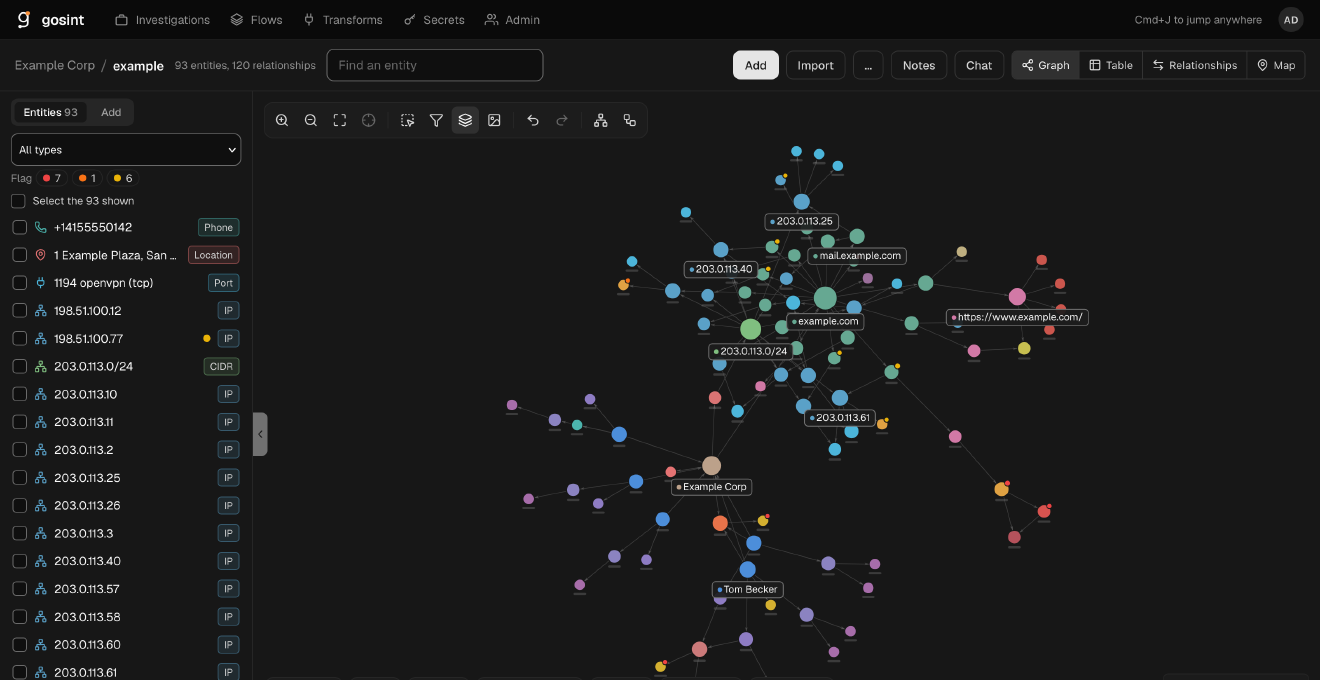
Graphs of typed entities
Domains, addresses, people, organizations, wallets, credentials, findings and more, detected from pasted text. An administrator can declare new types.
Transforms and flows
Built-in transforms for DNS, WHOIS, certificates, ports, reputation, breaches and CVEs, chained into flows that run by hand or on a schedule.
Your own transforms
A YAML template for an HTTP API, or a script in any language dropped into a directory, picked up while the server runs.
Sealed at rest
The graph, files, accounts and secrets are encrypted under a key only the unseal key opens. The server starts sealed.
Work together
Investigations with members and roles, live edits, undo, provenance on every entity, written analyses with mentions.
An assistant that proposes
Ask a model about the selected entities. It looks things up and runs transforms, and proposes changes for you to apply.
All sections
Browse the manual
Getting started
Install gosint, unseal it, claim it and run a first transform.
→
Guide
Working in gosint: investigations, sketches, entities, transforms, flows, import and export.
→
Administration
Running a server: configuration, the vault, accounts, sign-in, settings and deployment.
→
Extending
Your own transforms as templates or scripts, and your own entity types.
→
Reference
The configuration file, the command line, the entity types, the transforms and the keyboard.
→